
The Complete Security Engineering Interview Preparation Guide
From my experience as a Sr. Security Engineer @ Google

Most cybersecurity candidates are memorising definitions instead of learning implications.
More on The Engineers Club in the closing paragraph
I’ve been on both sides of the security engineering interview table, and the pattern is always the same: brilliant engineers walk in, confidently explain SQL injection like they’re reading from Wikipedia, then completely fall apart when I ask them to design a detection system for it in a microservices environment.
Watching labs is not experience. This guide exists because security engineering interviews have evolved into something unrecognisable from five years ago.
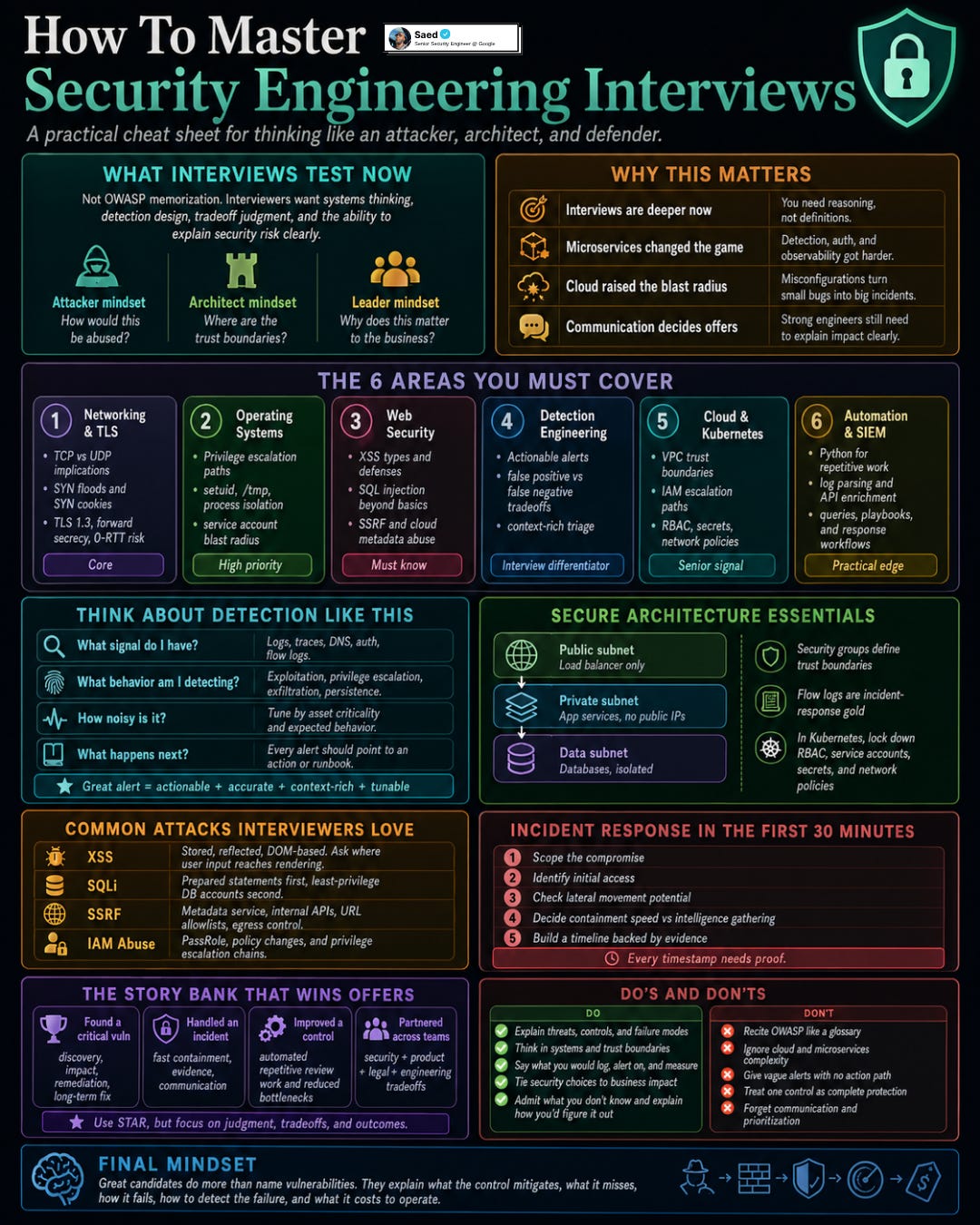
I once interviewed a candidate who could recite every OWASP category perfectly, then completely froze when asked how they’d secure internal service-to-service authentication in a distributed system. Interviewers want to see how you think about security, like an attacker when exploiting, like an architect when defending, and like a leader when explaining why any of it matters to people who sign checks.
I’ve spent the last 3 weekend distilling everything I wish someone had told me into this guide. It’s long. It’s detailed. And if you actually work through it, you’ll find a lot of return on your time investment.
Let’s get into it.
┌─────────────────────────────────────────────────────────────┐
│  THE FOUNDATION: FUNDAMENTALS THAT ACTUALLY MATTER          │
└─────────────────────────────────────────────────────────────┘
1. Core Technical Fundamentals
Networking: The Language Security Speaks
One thing nobody tells you about networking in security interviews: knowing the definitions doesn’t matter. Knowing the implications does.
TCP vs UDP: The Trust Story
TCP Three-Way Handshake:
Client                    Server
  |                         |
  |-------- SYN ----------->|  (Let's talk?)
  |<----- SYN-ACK ---------|  (Sure! Confirm?)
  |-------- ACK ----------->|  (Confirmed!)
  |                         |
  [Connection Established]
Everyone knows TCP is “reliable” and UDP is “fast.” But can you explain why SYN floods work[^1]? The server allocates resources after receiving a SYN, creating a half-open connection. Attackers send thousands of SYN packets with spoofed source IPs. The server’s connection table fills up. Legitimate users can’t connect.
Now and this is where senior-level thinking kicks in, how do SYN cookies solve this? They encode connection information in the sequence number, eliminating the need to store half-open connections. The server becomes stateless during the handshake. Beautiful, right?
